
The Tension Between the Employer’s Agenda and the Mediator’s Role
In workplace mediation, the employer is usually the client — the party engaging and funding the process. It is a structural reality of the work, and it creates a tension that deserves to be named: the party paying for the mediation is not the party the mediation is for.
As an independent mediator, my impartiality has to be absolute. I work with both participants equally, and it is their interests that sit at the centre of the process, not the employer’s. Over many years of restorative mediation practice, I have built two safeguards into the way I work that make this impartiality real rather than rhetorical — one at the very first conversation with the employer, and one signed by everyone in the room.
The blank page approach
Client contacts regularly ask me: “How much background information would you like?” My answer is almost always the same — the less, the better.
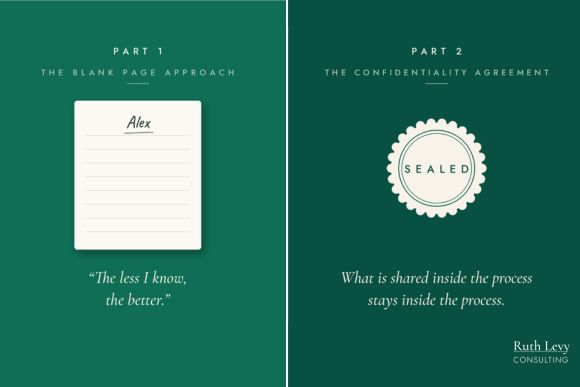
There’s a reason for this. I like to open each individual pre-session by telling the participant that I’ve received only a minimal briefing from their employer — because I asked for it that way. Then I show them my notebook: a blank page, with nothing on it but their name. This is the blank page approach. I’m here to hear their full story, in their words, for as long as it takes.
Something shifts in that moment. Participants arrive wary of the process — understandably so. But when they see that I haven’t been handed the employer’s version of events, my independence stops being a claim and becomes something they can feel. A little assurance enters the room.
My independence stops being a claim and becomes something they can feel.
The Confidentiality Agreement: everything inside the process is sealed
The second safeguard is signed, not shown. At the commencement of every restorative mediation, I ask both participants to sign a plain-English Confidentiality Agreement. It seals everything shared during the process — the individual sessions on Day 1 and the combined session on Day 2.
I explain why this matters. The combined session includes an accountability component — each participant speaks to how they let the other down, or contributed to the escalation of the conflict. That kind of honesty is only possible when it’s safe. The Agreement ensures that what is shared there cannot later be used against either participant — not by each other, and not by the employer in any subsequent internal organisational process, or any external administrative or legal one.
The Agreement doesn’t bar either participant from taking further action down the track. It simply means the contents of the restorative mediation stay inside the process.
The mediator is sealed too
The seal applies to me as well. Participants are advised that I, too, am sealed. I do not provide mediation reports to the employer. Any upward feedback is given only with the participants’ consent.
The one document that sits outside the seal is the Statement of Intention — reached and signed by the participants themselves, setting out agreed behaviours and actions moving forward. This is the only document provided to the employer, and its purpose is supportive: to help both participants stay aligned and engaged with what they agreed to build.
When the employer’s agenda makes mediation the wrong choice
Participants mostly leave restorative mediation with a sense of relief and renewed hope — a restored working relationship and a clear path forward. But occasionally they walk back into a conflicting agenda: an employer who wanted the mediation to fail, so that an investigation could be initiated and disciplinary outcomes pursued.
Restorative mediation asks for the slow re-earning of trust and respect over time. If an employer can’t — or won’t — give one or both staff members a genuine opportunity to build that traction, then mediation of any kind, and restorative mediation in particular, is not an advisable choice.
The blank page and the seal exist for the same reason: the process belongs to the two people in the room. When an employer engages restorative mediation understanding that — and most do — it is one of the most powerful interventions available for a damaged working relationship.
To learn more about the structure of the two-day process, visit How It Works.